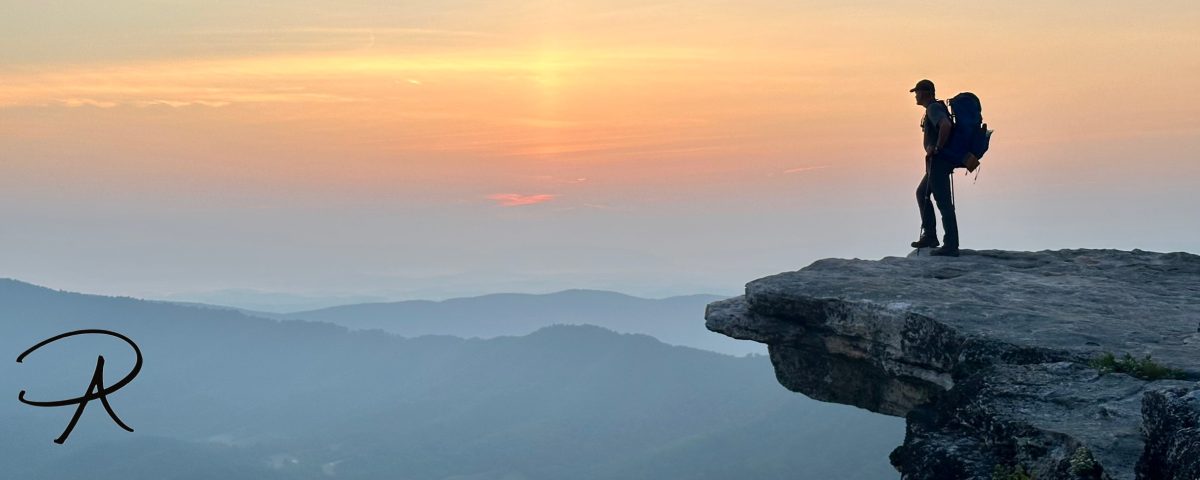

Giro d’Oregon (Grand Tour of Oregon)

Although the next series of blog posts will have absolutely nothing to do with Everest Base Camp, I hope they will describe another adventure we have just begun with our good friends Marty and Sue Bridi.

For the past seven years I have made an annual trip out to Oregon to enjoy a fantastic couple of days of rafting, camping, and camaraderie with family and friends. My sister Karen and her husband Larry generously host us for this annual event, which I always look forward to. Last year, my wife Joanie joined in on the fun for the first time (because it allowed her to visit our son, John, who was living here at the time). Well… it turned out that she had such a great time that we both thought it would be a nice event to share this year with Marty and Sue, who had never been to Oregon.

With Joanie’s positive report and encouragement… which amounted to “if I can camp in a tent and use a vault toilet for a couple of days on the river and have fun, then I think you’d enjoy it too… why don’t you think about coming along next year?”

So, here we are on what we are affectionately calling the “Grand Tour of Oregon.”

It all started today with a 3:30 a.m. wake up for the early flight from Virginia to Oregon. Surprisingly, at least for me because I generally have horrible luck with the airlines, both flights were perfect, reasonably comfortable and actually arrived early! To be fair I think I have to give credit to our former parish priest, Father Keith Cummings, who we coincidentally bumped into at the airport as he was leading a group of high schoolers and chaperones on a mission trip to the Dominican Republic. Father Cummings graciously offered a blessing on us for our trip as we parted ways at the bottom of the escalator.

Once we arrived in Portland, we got the rental car with no delay, headed out for a quick lunch, then made the scenic drive along the Columbia River Gorge out to Multnomah Falls. Along the way we took a scenic detour to the south ridge above the river and stumbled into the Vista House Overlook at Crown Point, where we were able to enjoy some panoramic views of the river and gorge which forms the border between Oregon and Washington.

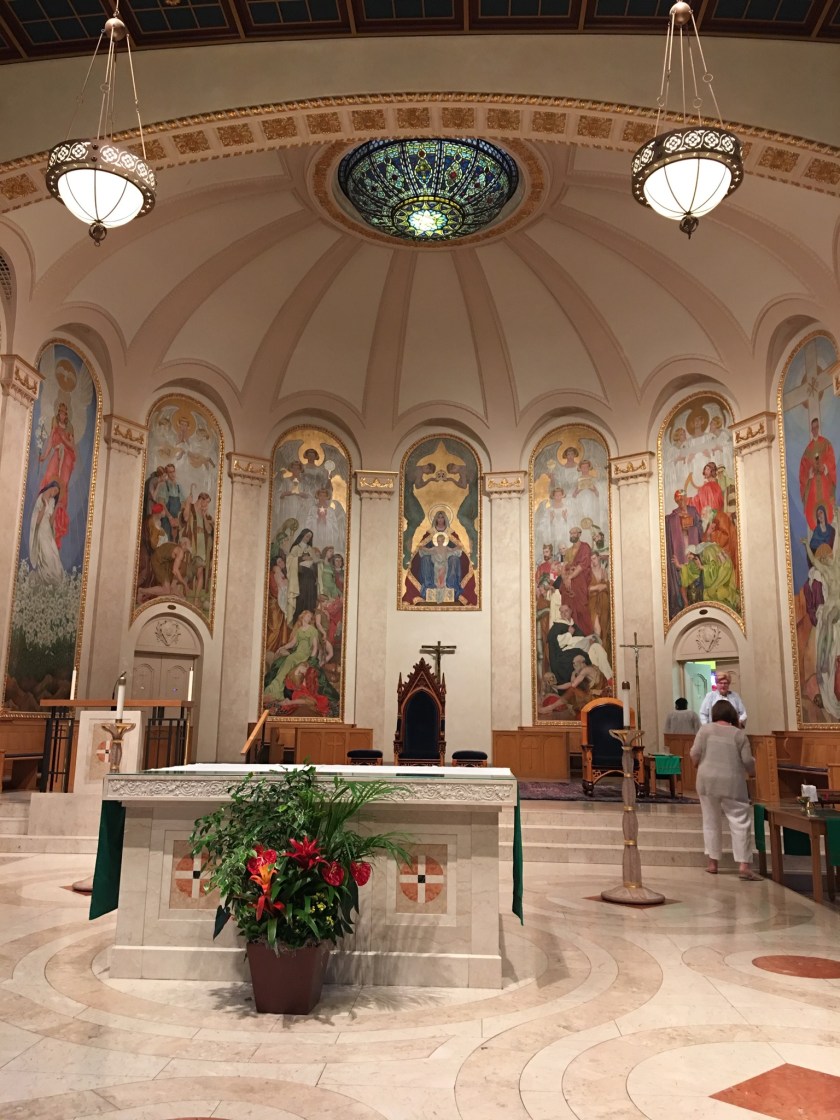
With the early wake-up, cross-country flight, and scenic visits, we were all beginning to wear out, so we checked into our hotel to freshen up, get a short nap, then head into Portland. We decided to go to Mass at St. Mary’s Cathedral of the Immaculate Conception, a beautiful cathedral in downtown Portland (which just happens to share the name of our home parish in Fredericksburg, St. Mary of the Immaculate Conception!)
04BB46EC-6833-409F-9B10-045CE7CAF08B
St. Mary’s Cathedral of the Immaculate Conception

Then it was time to walk the streets of Portland, a unique city with a tremendous about of social and socioeconomic diversity. If you are into “people watching,” Portland won’t disappoint! Since we were in the area, we couldn’t pass on the opportunity to get a tasty snack at the famous Voodoo Donuts… I’m pretty sure Mr. Voodoo himself served us!

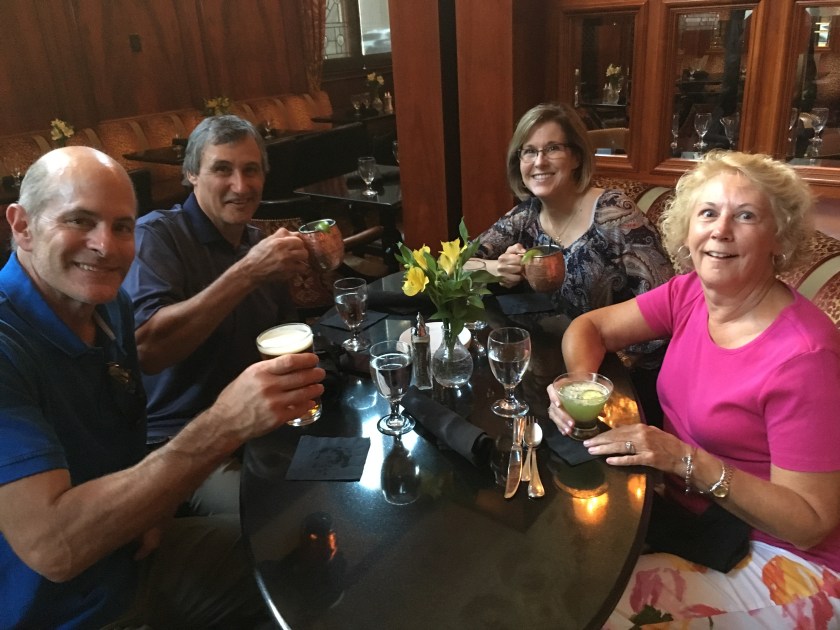
Then it was off to the Benson Hotel for a drink and some appetizers at their ornate and historic bar. Now, this was a happening place where we even got invited to peak into a wedding reception for John and Joe… it looked like the couple and their largely male guests were having a great time!…
00B90774-D9EC-48F8-A54A-25B909221110
Cheers from Don, Marty, Joanie, and Sue

Finally it was time to get back to the hotel to get some rest (since we’ve essentially been awake for 24 hours) before embarking on the many other adventures we have planned.

img_0354-8
destinationadventure.org

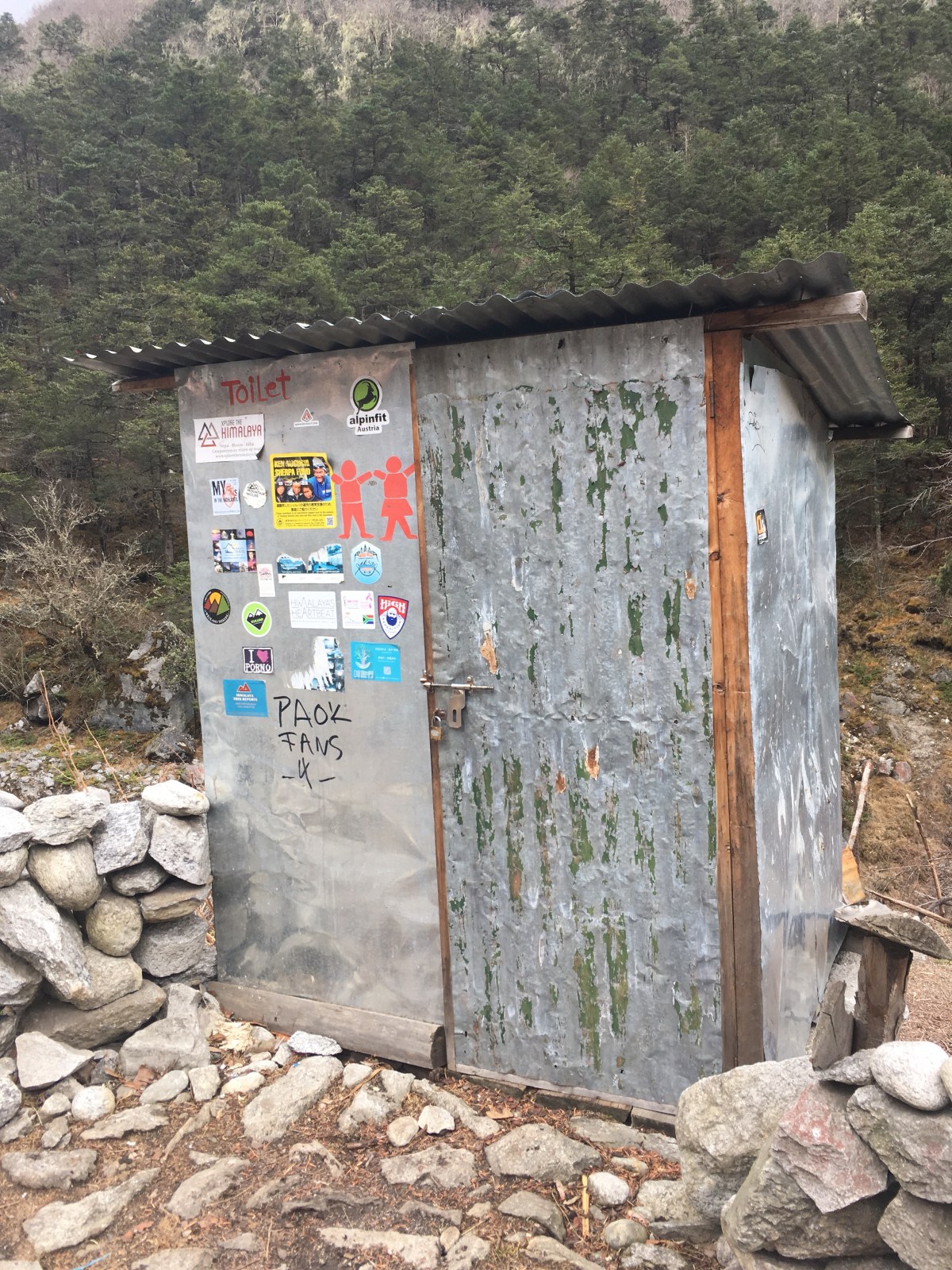
Bathrooms… the “good” and not so pleasant!

Its been about one month since our return from Nepal and our trek to Everest Base Camp… and I’d do it again in a heartbeat! This was the rare vacation that was so indelible that I often find myself reflecting back on the whole of the trip and happily sharing the experience with anyone who finds interest in the story. So why, you may ask, does a two-week hike in the mountains leave such a deep mark? There are several reasons that come to mind:

  1. We were immersed in the Sherpa culture, with daily opportunities for glimpses into the lives of these amazing people. Although life is simple, when compared to western standards, it is substantive, family centric, grounded in a deep faith, and generally unencumbered by to “noise” of 24 hour news cycles and non-stop social network and news “feeds.” Life is very much outwardly focused and not insular and self-involved.
  2. We set a goal and achieved it… as a group! Unlike a lot of vacations that are focused on either relaxing or sightseeing, this vacation required preparation and work. We all had to commit ourselves to carving out the necessary time to physically prepare ourselves in the months leading up to the trek. This took on many forms (which you can read about in some of the earlier blog entries), but paid dividends on the trail. As a result, both of our goals were achieved: making it to Everest Base Camp and reaching the summit of Kala Patthar.
  3. The time spent in preparation, conversation, and shared experience with Ron, Karen, Alan and Deb, and me is something both lasting and unique between us.  In the months leading up to the trek, our family bond was reinforced through the numerous voice, email, and text conversations to compare notes about our preparations and gear. During the trek, we were reminded about how different each of us are, but as a whole how our various strengths melded in a way that made us stronger as a group than any of us could have been on our own.

Okay… onto the real subject of this post, the long-promised “Bathroom Blog!”

We all have to expel bodily waste, but sometimes we can’t be too choosy of the “facilities” we get to use. In the Himalaya, we certainly experienced just about every option conceived by man… Of course the most sought after option was the “sit-upon flush toilet,” while the least preferred option was affectionately called the “squatty potty.” Other options were what I call “slats” (the outhouse version of the squatty potty), and of course au natural. But… lest you think that one is better than the other, you also have several additional factors to consider, including cleanliness, flush-ability, and accessibility, before holding your nose and jumping in.

There were times when we’d stop for a tea break along the trail, and the first one to the bathroom would always report to the others what to expect. After awhile, we developed a sort of shorthand, like “nasty squatty” or “wide slats, don’t fall in!”or “normal toilet, pretty clean.”

Of course we got the nature experience too! For the gals, this meant finding a boulder for privacy or some other secluded spot. If none was available, a few of us would simply turn our backs and form a privacy wall. For the guys it was a bit easier to simply move off of the trail… the nice thing about this option were the views enjoyed while doing your business, so in a lot of ways, this was the preferred choice.


img_0354-9
destinationadventure.org

Base Camp vs. Summit Bid

When describing this trip to family, friends and acquaintances, invariably someone would ask if any of us were ever interested or planning on actually going beyond Base Camp and climbing Mt. Everest. To put it succinctly… NO!

“But why?” you may ask…. Well let me list the many reasons:

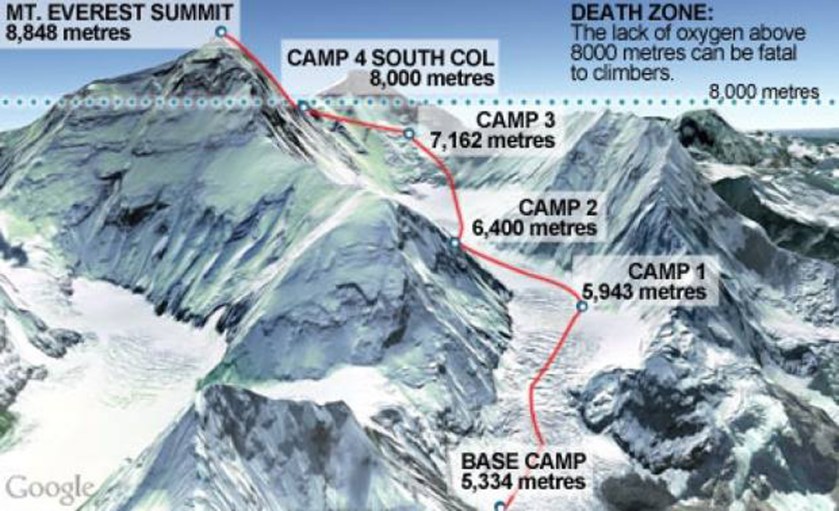
  1. There is no need to name any part of our trek something as ominous as “The Death Zone” (the part of Mt. Everest that lies above 8000 m where climbers are racing the clock to survive during their final push to the summit).

    Everest Route
    Everest route from the south (Nepal)
  2. Our permit fee is $40… the permit fee to go onto the mountain is $11,000!
  3. Our trekking company has a 99% success rate of guiding clients to Base Camp, the commercial climbing expeditions won’t even provide a success rate.
  4. No frostbite… We fully expect to come back with all our fingers and toes!
  5. The worst we encounter during acclimatization days (when we hike to a higher altitude during the day, but sleep at a lower altitude to help our bodies adjust to the reduced levels of oxygen) maybe a flatulent yak… as opposed to building size blocks of ice that shift and move and frighteningly deep crevasses in the Khumbu Icefall (the glacier all climbers have to transit multiple times).
  6. The landmarks we encounter along the way are spectacular Himalayan peaks, rivers, suspension bridges, and villages… On the mountain some of the route markers are the permanently frozen bodies of dead climbers.
  7. Our equipment is no more complex than any weekend day-hiker requires; no need for crampons, ice axes, fixed ropes, oxygen canisters, tents precariously placed next to a 2000 m cliff, etc.
  8. Our evacuation insurance covers 100% of the route we travel (but hopefully we won’t need it).
  9. Our prep consisted of roughly three months of weekend hikes and gym workouts. The prepared Everest climber requires multiple years of high altitude mountain climbing experience and 30 days training at Base Camp and above.
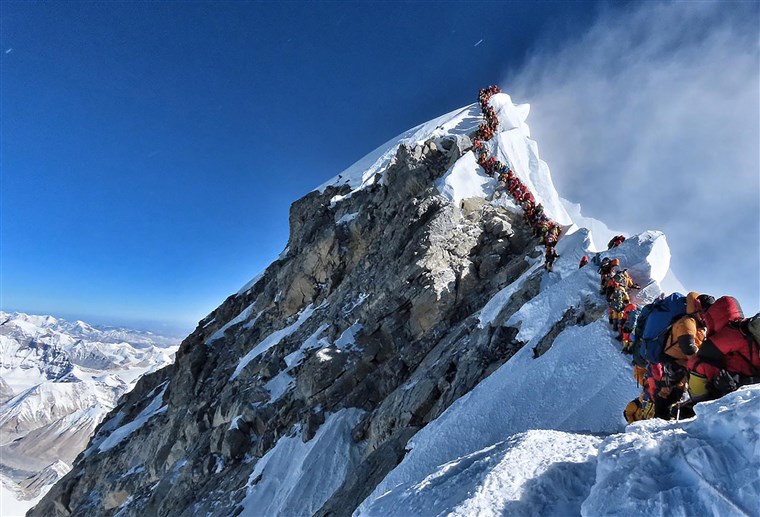
  10. Weather won’t impact our goal of reaching Base Camp, whereas for the 1000+ climbers who pay upwards of $75,000 to attempt the summit are all compressed into a 2 or 3 day “weather window” creating a traffic jam at the top of the world with virtually no oxygen, and bitterly cold temperatures.

    7CB8DDFB-3E94-48CB-8B76-C93C68624EC2
    Traffic jam at the top of the world… too many people, means too much time in the Death Zone, which12 equates to increased risk and more deaths.
  11. Our trip cost are consistent with the price of a nice beach week vacation, vs. the cost of a luxury car or college education.
img_0354-9
destinationadventure.org

Epilogue

If you’ve enjoyed following this blog and think that someday you may be interested in a similar adventure, I would strongly encourage you to put aside any inhibitions you may have and go for it. Although this particular trek was at times physically demanding and the living conditions somewhat austere, the opportunity to see the Himalayas “up close and personal,” while immersing ourselves in the Sherpa culture was one I will never forget.

Here are a dozen things to consider if you are interested:

  1. Don’t think that you can only do this if you are an avid outdoorsman with a lot of experience. We saw all kinds of people on the trail, from entire families with young kids, to men and women in their 70’s, and everything in between. We even met a gentleman with terminal cancer.
  2. Take the time to properly prepare. Although our group committed to this trek just 4 months before it started, we took the time to research trekking companies, learn about what we would experience, and prepare ourselves physically.
  3. Physical preparation is key. Taking the advice from our trekking company (Ian Taylor Trekking), we hiked at least every other week. These hikes ranged from 7-12 miles while carrying a 20lb backpack. Additionally, gym prep is critical for aerobic fitness and to build strength. I would strongly recommend the stair climber machine to build the leg strength for a trek like this one. Gauge your own fitness level to determine how much pre-trek prep you will need.
  4. Expect and accept the austere living arrangements. We were lodged and fed in local tea houses. These ranged from reasonably comfortable with in-room bathrooms and showers, to a basic room with nothing more than a small bed to sleep on and a shared toilet at the end of the hallway. All of these rooms lack heat, have plywood construction with no insulation, and rarely have electricity.
  5. Follow the advice of your guides to acclimatize properly. The elevations on our trek ranged from 8,900’ to 18,500’. In order to mitigate the affects of Acute Mountain Sickness (AMS), we spent 3 of our 12 trek days acclimatizing to the higher elevations. Additionally, we took a 125mg dose of Diamox each morning and night to increase the oxygen carrying capacity in our blood.
  6. Keep a slow but steady pace. You should be able to hike without getting out of breath. If you have to constantly stop to catch your breath, you are going too fast. While trekking in the Himalayas, it is usually the “tortoise” that beats the “hare.”
  7. Get the right gear and test it during your training hikes. Boots, backpacks, and all the various clothing layers are critically important. 
  8. Despite the austere conditions, maintain the best hygiene possible. Bring soft soap and hand sanitizer to keep you hands clean at all times. Most of the bathroom facilities do not have running water, so it is absolutely critical to wash/sanitize thoroughly.
  9. I highly recommend sleeping with ear plugs. Most tea houses feature thin walls and floors, so you can hear everything. If you want a sound sleep, ear plugs can block most extraneous noise.
  10. Be willing to try new foods. Generally speaking, as you get to the more remote villages, the food becomes pretty basic… rice, noodles, eggs, vegetables, etc. Also, bring along some of your favorite snacks, and flavor packets/drops for water since you will be drinking up to 5 liters per day.
  11. Communications are spotty at best. In most villages you can purchase WiFi access, but bandwidth is limited, which may affect what you are able to do.
  12. Bring along small gifts for some of the children you will encounter along the trail. There is a weight limit for your gear, so lightweight items are best. 10-15 items will allow you to periodically give a gift, without carrying too much extra weight.

Samples of various lodging at Tea Houses along the route:

img_0354
destinationadventure.org

Day 14: End of the Line

We arrived in Lukla yesterday afternoon for our final night before heading back to Kathmandu. Our hotel is the Buddha Lodge, which is located right at the end of the runway, so we get to see all the action of helicopters and airplanes arriving and departing from this high altitude airfield that serves as the logistics and transportation hub for the region.

Yesterday afternoon, just prior to arriving in Lukla, we got a break from the rain and were invited to have tea at the home of our guide, Nigma Sange. After completing our journey, our head guide, Kalden Sherpa also invited us to his home for tea and we got to meet his beautiful wife Lakpa who is 8 1/2 months pregnant with their first child. They were so gracious in allowing us a glimpse into their lives. Both are very excited about the pending birth! Interestingly, there is a small hospital here in Lukla, but when the time comes the only way to get there is to walk up and down steep, uneven, stairs and pathways… another example of the strength of these people.

img_1944
Our gracious hosts and expecting couple, Kalden and Lakpa.

Due to a closure of the main runway in Kathmandu, we are once again forced to consider a helicopter flight (just like when we flew into Lukla 12 days ago) in order to avoid what could end up being a 1 to 2 day delay, which would impact our return flight to the U.S. Although we were all hoping to experience an airplane flight into or out of this airport, we can’t afford the domino effect of continued delays.

img_0354-1
destinationadventure.org

Day 12 & 13: Going Up to Go Down

Departing Periche with stunning views of Thamserku and Kantega.

In the past two days we have hiked 21 miles while descending from Periche (13,900’) to  Lukla (9300’), crossed 11 suspension bridges over the Khumbu and Dudh Koshi rivers, and seemingly spent more time going up than going down due to the constantly undulating terrain.

Despite the long days, we continued to be impressed by the Sherpa people who live in the many small villages along the trekking route. This gentle culture is generous and kind. We were fortunate to have three of the very best guides (Kalden Sherpa, Nigma Sange, and Dorjee Sherpa) who cared for our every need, shared their culture and knowledge, and even opened their homes to us. This has been an experience that none of us will forget.

CA2D6FFA-ACC5-4C62-8CE4-2A679B8CA71B
Nigma, Dorjee, and Kalden at the monument to Tenzing Norgay.

Some days have been challenging, and a few in our group  dealt with symptoms of Acute Mountain Sickness (nausea, headache, loss of appetite, etc.), but in the end we pushed through the difficult moments and were rewarded with inspiring views and indelible memories of Nepal.

img_1899
Our last view of Everest…
img_0354-2
destinationadventure.org

Day 11: Sunrise over Everest!

Just to dispel any thoughts that this is a relaxing vacation, allow me to give you today’s Trek Itinerary:

  • 3:00 am: Wake up after a night of virtually no sleep due to the altitude.
  • Put on practically every piece of layering you have.
  • 3:30 am: Enjoy tea and biscuits (cookies) in the unheated and unlighted dining area without disturbing the 4 or 5 Sherpa guides who are sleeping there.
  • 4:00 am: Begin an invigorating early morning hike to the top of Kala Patthar to work on aerobic fitness. This hike features a 3.75 mile out & back trail with a “slight” incline, a starting elevation of 16,950’, and the peak elevation at a “breathtaking” 18,500’!
  • 6:30 to 7:00 am: Enjoy stunning views of Mt. Everest and other Himalayan peaks (due to the unpredictable weather… we can offer no guarantees)
  • 7:00 am: Enjoy a gravity assisted descent back to our start point.
  • 8:00 am: Breakfast (enjoy the same selections you’ve had all week, but remember to avoid all cheeses and meats!)
  • 8:30 to 9:00 am: Rest, but remember to pack all your gear for the next event on the itinerary.
  • 9:30 am: Enjoy a refreshing 8.25 mile hike, featuring winding inclines (both up and down) with lots of rocks and boulders to test your balance and footing.
  • 4:00 pm: Arrive at your destination for the day, the rustic village of Periche, lying in the Khumbu River valley. Enjoy lovely views of yaks grazing outside your window as you recount the experiences of the past 12 hours.

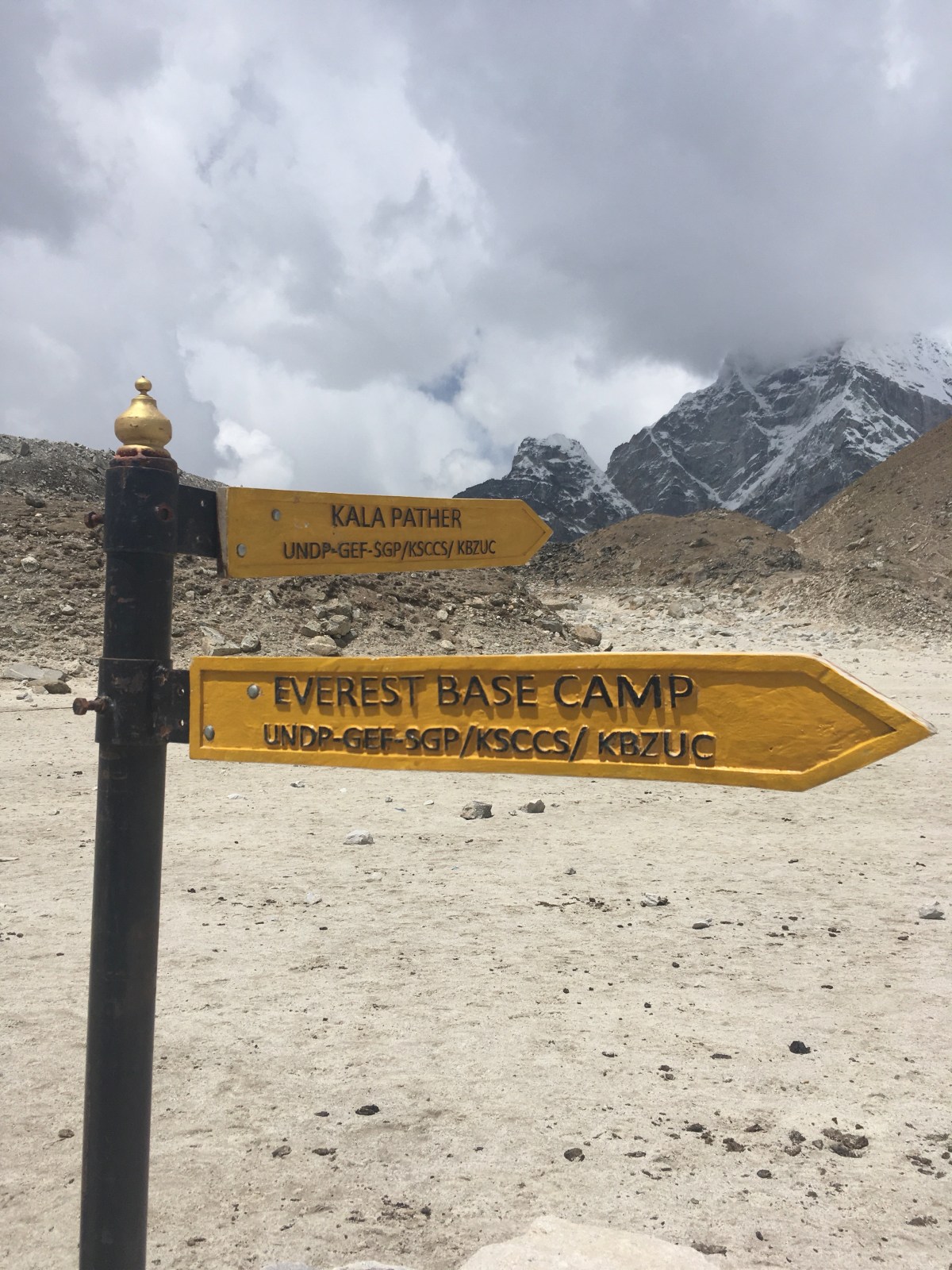
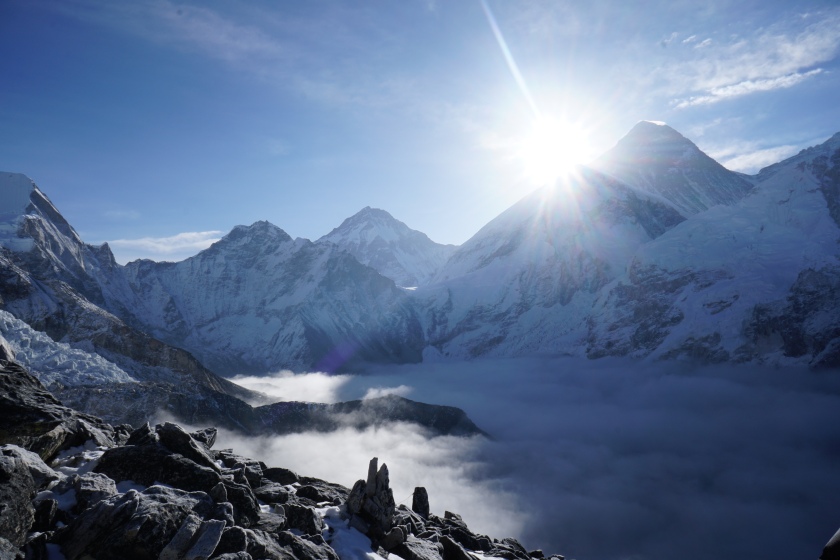
Seriously, it was a long grueling day, especially with the ascent of the 18,500’ Kala Patthar. We began in the dark with sub-freezing temperatures and fog, with absolutely no guarantee of seeing anything when we got to the top. When we finally did reach the summit 2.5 hours later, it was overcast, but there were glimpses of the sun shining on Pumori through the cloud cover to give us hope that the mist would lift. Our patience paid off and we were rewarded with clear skies and a 360 degree view of the Himalayas. We were also witness to the sunrise as it peaked from behind Everest… an amazing sight and experience. I’ll let the pictures tell the rest of the story.

E9E136FA-D1C9-4379-943B-E192B7D9481C
Summit of Kala Patthar (18,500’) with Everest and Nuptse..
dsc01358-1
Sun rising behind Everest with fog in the valley below.
gopr1370
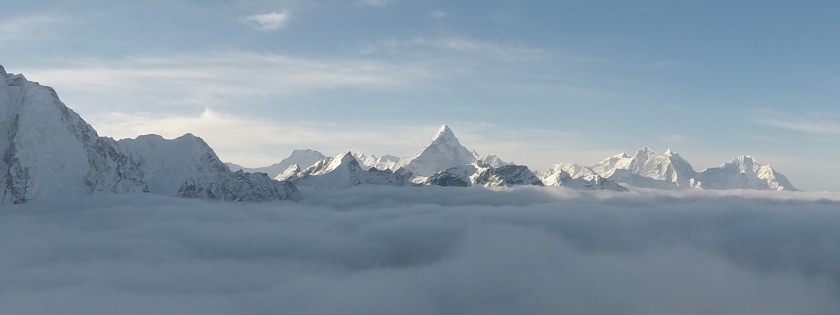
Ama Dablam and other peaks from summit of Kala Patthar.
gopr1375
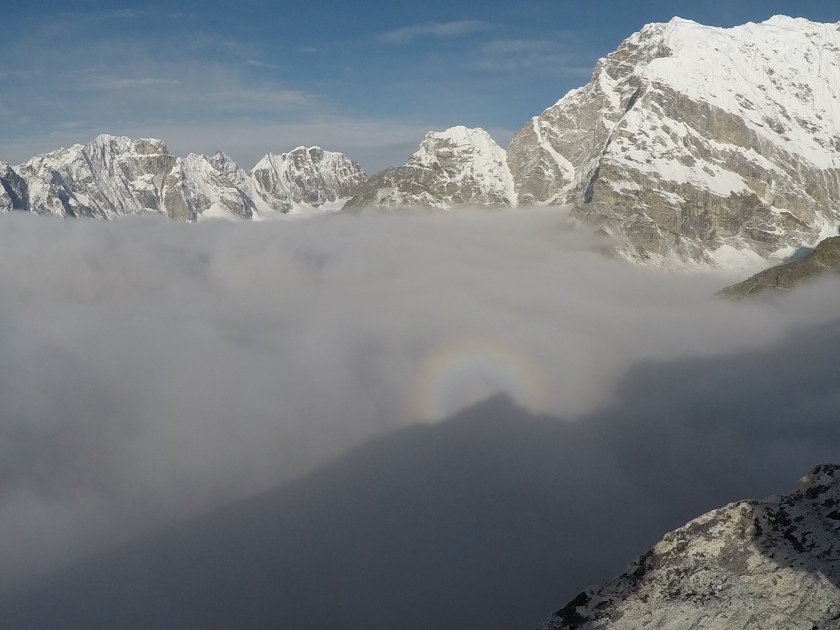
Rainbow around shadow of Everest!
2D970AF2-51D3-475F-9344-12E891937558
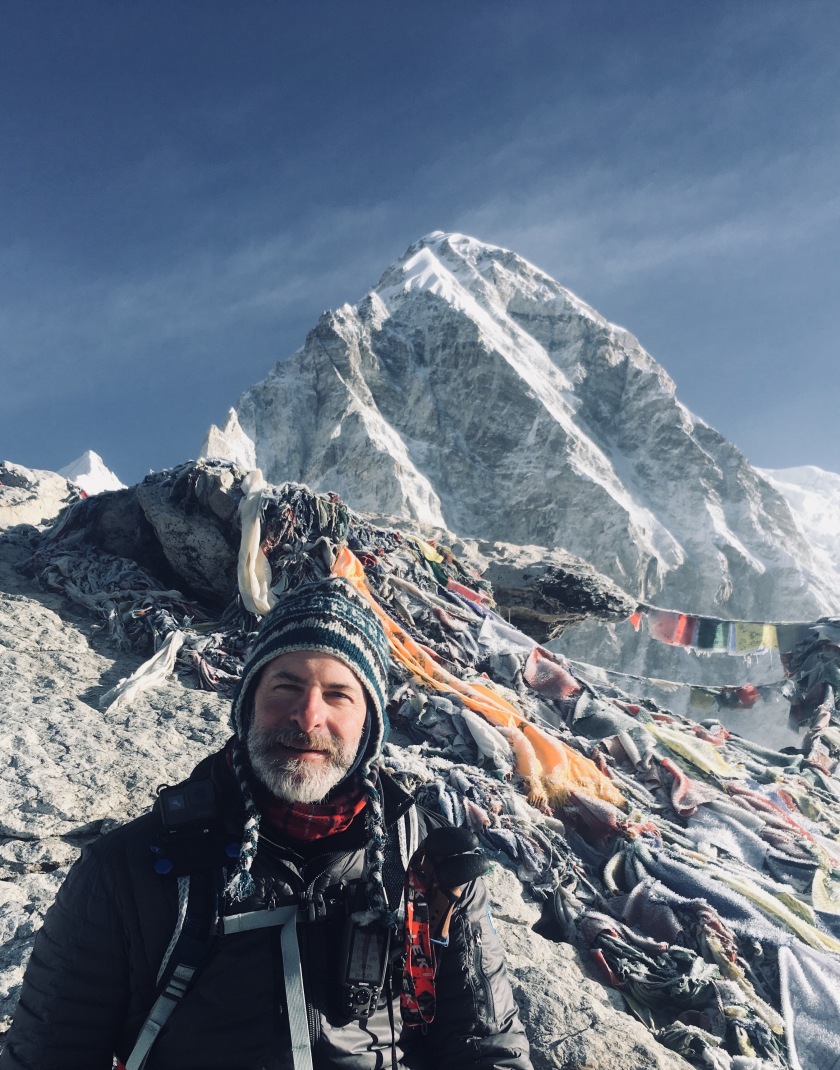
On summit of Kala Patthar with Pumori looming.
img_0354-3
destinationadventure.org

Day 10: We Made It!!

Today was a long day with a satisfying ending. We started our day with a 6:15 am start from Lobuche, after a night of limited sleep due to oxygen levels that are about 50% of what is available at sea level. After leaving Lobuche we hiked uphill for about four hours from 16,300’ (4,970m) to 16,950’ (5,165m) to Gorak Shep, the final, remote outpost prior to Mt. Everest Base Camp.

img_1724-1
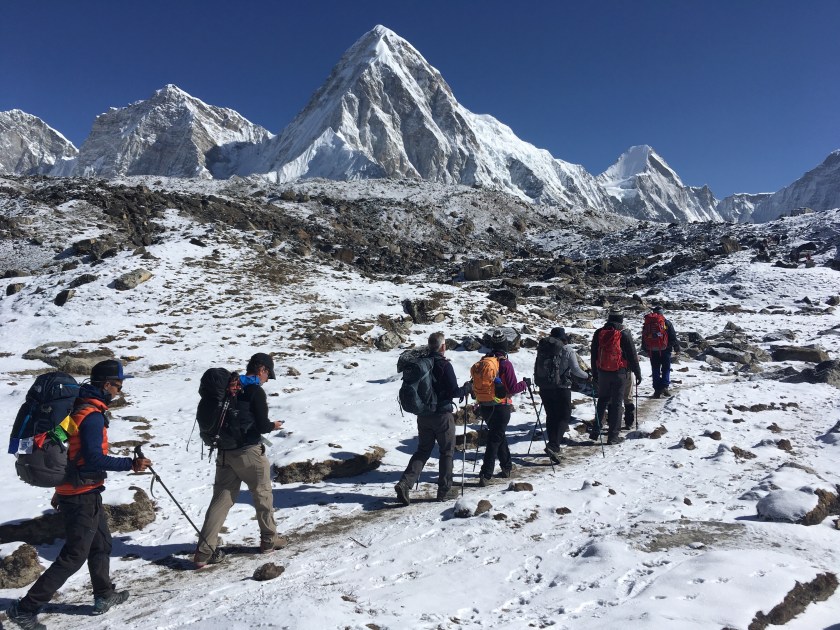
On the trail from Lobuche to Gorak Shep, with a spectacular view of Pumori!

We enjoyed a quick lunch of Sherpa Stew (similar to a hearty chicken noodle soup, without the chicken) and some hot chocolate. Then it was off for another 2.5 hr hike to the base camp. This hike featured very rocky terrain, because we were essentially hiking up the valley created by the Khumbu Glacier. Along the way we caught encouraging glimpses of base camp, which is essentially a widely spread campsite of about 4000 people from various summit expedition teams and all the support staff it takes to feed and house the climbers for the several weeks it takes to prepare for their summit bids in late April thru late May.

dsc01273
Everest Base Camp!

Our entire group succeeded in reaching base camp! After the requisite photos, we headed back to Gorak Shep for some well earned rest before a very early 3:00 am wake up for tomorrow’s grueling hike to the peak of Kala Patthar, followed by a long descent to the small village of Periche… more on that experience later.

img_0354-4
destinationadventure.org

Day 8/9: Acclimatization Hike / Final Stop Before EBC

Day 8: Acclimatization Hike to 15,300’ (4,665m)

We spent the first of two nights in Dingboche at an elevation of 14,300’, which allows us a chance to acclimatize to the higher elevations we will experience in the next couple of days. Our morning was spent taking a leisurely hike up the hillside behind the village to an elevation of 15,300’, which is at least 800’ higher than the highest point in the continental United States (aka the lower 48). We relaxed at the top, taking in the views all around us while we became acclimated to the thinner air.

078C604F-D65E-430B-B24E-EBBE5CB95FF7
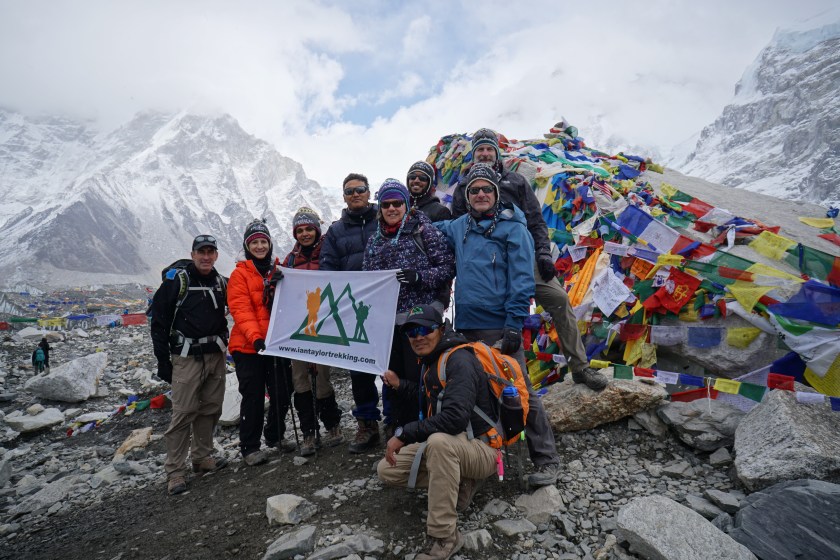
The group at the top of our acclimatization hike.

While we were relaxing, a vigorous debate broke out between the Sherpa guides and us, the clients. Our fantastic guides, who have a tremendous amount of knowledge about the Himalayan region, were absolutely insistent that we were sitting at 4,800m (15,745’), while we were equally convinced that we were at 4,665m (15,300’), due to three separate GPS devices saying we were at that elevation!  It was actually quite amusing to hear our guides debating in Nepalese while they consulted a map of the region. In the end they concluded that they were right. So in the interest of not creating an international incident, we politely agreed with their conclusion while we held onto our view that a GPS locked into 12 different satellites with an accuracy of +/- 12’ was really the elevation we had attained. After about an hour at the top, we descended steeply back down to our tea house, the Summit Hotel.

This particular hotel seems to have an on again, off again relationship with running water, which makes it a bit of a guessing game when it comes to using the toilet; I will probably be writing a blog post at some point simply to describe the wide variety of bathroom experiences we’ve “enjoyed” during our trip.

Click here for the “Bathroom Blog” post


Day 9: Dingboche to Lobuche (final stop before EBC)

We are excited to be close to the destination of the trek, Mt. Everest Base Camp, and everyone is preparing for the long days ahead. Today was our final “short” day as we hiked from Dingboche to the even smaller village of Lobuche, which lies at an elevation of 16,175’ (4,930m). Half of the 5.7 mile hike was in a large gradually rising steppe which was very pleasant, especially since the sun was shining and there was only a light breeze. After crossing the headwaters of the Khumbu River, which originates at the famous Khumbu Glacier at the base of Everest, we (… that should really read “I”) enjoyed a nice lunch of fried rice and garlic soup… I thought it was pretty good, but some of the more picky eaters chose to forego it in lieu of the snacks they brought with them.

32544F5B-917D-4F57-BE4A-1767AA6AF380
Ron, Alan, Karen, and Deb looking strong on the way to Lobuche!

After lunch, the real work began as we climbed a steep rocky path up to Lobuche. Along the way we passed the memorial site to some of the many climbers who have lost their lives on Everest. From this point forward, the days will be very long. Tomorrow, April 16th, we will pass through Gorak Shep, a very small outpost a few miles from Everest, on our way to Everest Base Camp (17,600’ / 5,365m). Then we will return to Gorak Shep for the night. The next morning we will get a very early 4:00 am start so we can climb to the top of Kala Patthar (18,500’ / 5540m) for what we hope will be an up-close sunrise view of Mt. Everest. Then the long hike back thru Gorak Shep (for breakfast), before we head downhill for about 7.5 miles all the way to Periche. After a night there, we have two more long hikes (Periche to Namche Bazaar & Namche Bazaar to Lukla).

img_0354-5
destinationadventure.org

Day 7: Himalayan Highway and Animal Drama

This morning we woke to frost… on the inside of our room’s windows! I never thought I’d need an ice scraper just to look outside, but once we did clear the ice, our reward was a clear blue sky and a view of Everest! Since it had snowed the previous evening, it was quite icy outside, a bit breezy, and very cold. Thus, it was time to plan the various clothing we would wear and the extra items we would carry in our packs. As described in the “Day 6: “Wow!!”” post, the weather can change quite a lot throughout the day, so we need to plan for a variety of conditions.

A6F5715E-B735-4826-89F0-A95CD2E27174
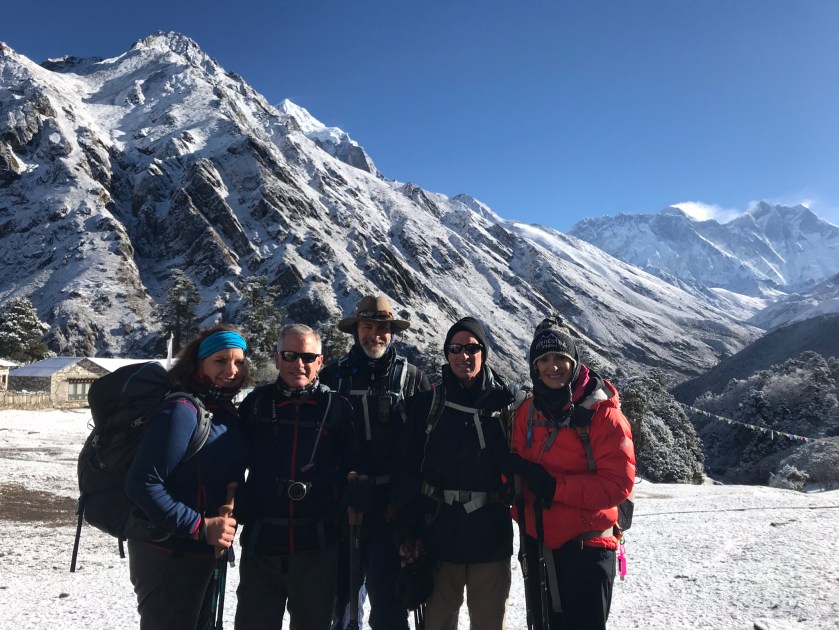
Deb, Alan, Don, Ron, and Karen bundled up at the beginning of our hike from Tengboche to Dingboche, with the peak on Everest just visible…

For most of us we chose a middle of the road set-up which included several layers on the upper body, heavy gloves, wool hats, buffs, and a single layer on the lower body. We also carried our rain gear, which doubles as a windbreaker, and our down jackets… just in case.

The Day 7 trek was a 6.5 mile, 7 hour hike from Tengboche to Dingboche (a small farming village at 14,150’ elevation). Now, some of you may be thinking “how in the world does it take 7 hours to hike 6.5 miles?” Well first, we are at very high altitudes, so this is very much a journey rather than a sprint. The slow pace has a few benefits, namely that we can maintain the pace without breathing too heavily, which helps to prevent respiratory issues. Oftentimes on the trail, we will see other trekkers who had passed us with a faster pace, only to see them again due to their need for more frequent stops to catch their breath. The slow pace also allows us to enjoy the stunning scenery all around us, and take pictures of what may be a once in a lifetime experience.

Today’s hike actually started with a downhill section on an icy trail through a beautiful juniper and rhododendron forest. The trail was quite busy considering it was only 7:30 in the morning. It felt as if we were on the main artery of the “Himalayan Highway,” sharing the trail with other trekkers, numerous porters, and several large groups of yaks and jupje (a hybrid between a yak and a cow). We continued our descent until we once again crossed the Dudh Koshi river using a high suspension bridge. We then began a gradual climb that would last the rest of the day.

DCIM100GOPROGOPR0797.JPG
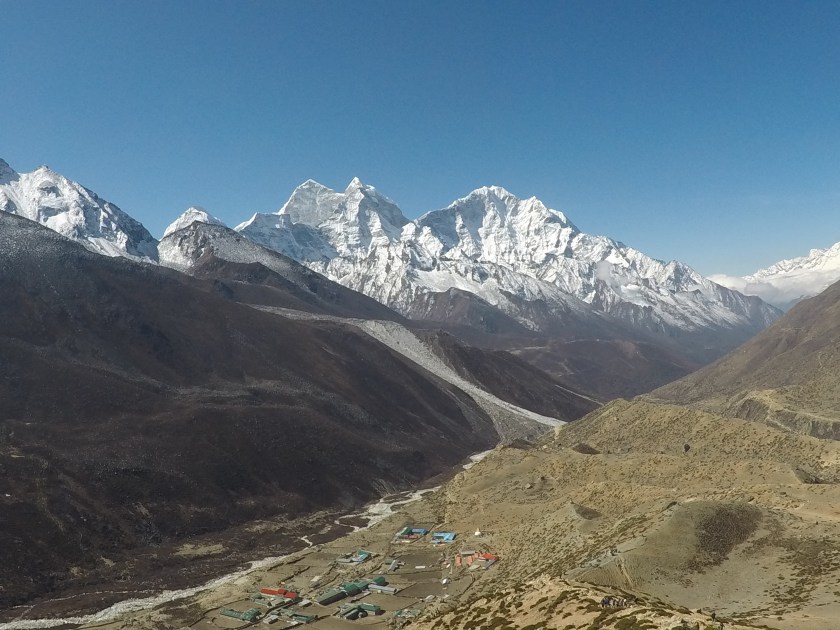
Looking back at Thamserku (foreground) and Kantega from about 13,000’…

Along the way we were once again surrounded by high and rugged mountains, with an added bonus of some wildlife and dramatic animal moments. Early in the day a yak somehow got stuck when it’s cargo got tangled in a tree branch. When the handler finally freed it by breaking the branch, the loud crack spooked the animal and it began to run uncontrolled through the trees until its cargo slipped to the side and again got stuck, causing this large, fast moving animal to come to a sudden stop, seemingly stunned. Later in the day we got a close view of two wild mountain goats grazing in the hillside above the trail. But, perhaps the most dramatic moment came as we were approaching Dingboche.

On the outskirts of town we could see a large pack of dogs harassing a couple of yaks grazing in their pen. Another dog, which had been following our group since our lunch stop several hours earlier, began to bark. Immediately the pack turned their attention from the yaks to this new threat, and sped directly toward our group. What ensued was a frenzy of dogs running all around us, while our companion dog stood her ground, fearless amongst the threatening pack. It was certainly a unexpected sight, but we arrived safely in Dingboche where we will be spending the next two nights with another acclimation day in between.

img_0354-9
destinationadventure.org