
Day 12: Summit Chimborazo [20,562’ / 6,267m]… at least that was the plan!
Author’s Note: The elevation of Chimborazo cited on this page is from the Global Navigation Satellite System (GNSS) survey of Ecuador peaks conducted in 2016. This survey used GNSS data to update measurements derived from barometric and trigonometric triangulation methods used in the 19th century.
Background Info
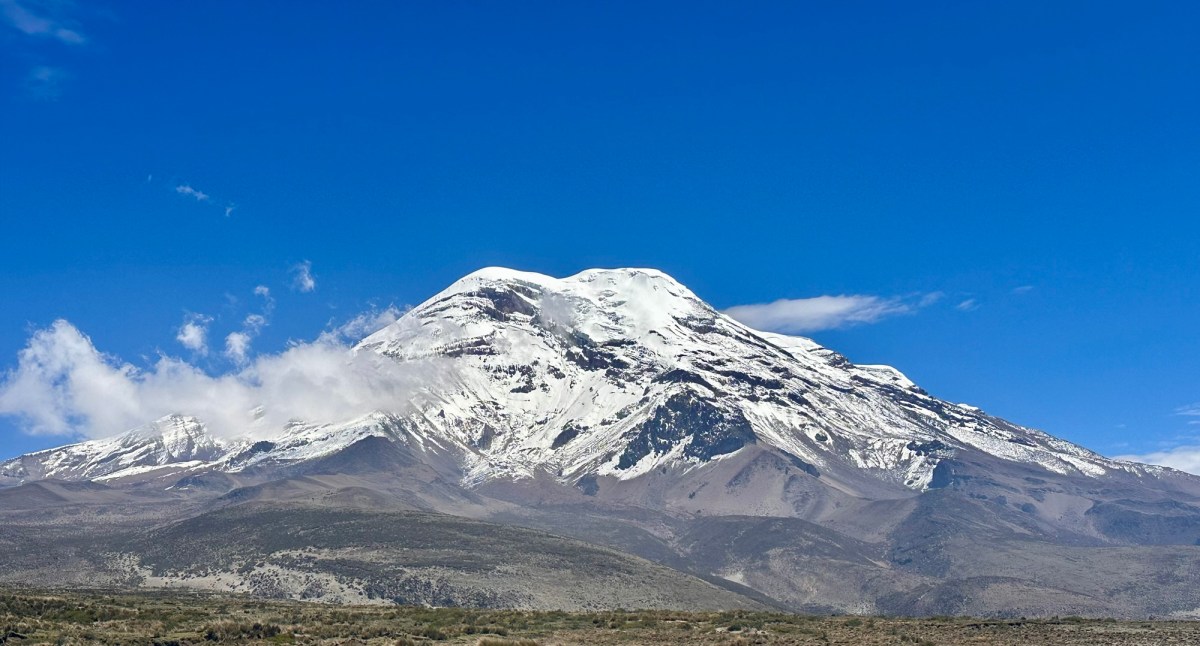
Chimborazo is massive inactive double volcano that, based on its eruption history, features four distinct peaks. The highest of these four peaks is the Whymper summit, followed by Pico Vientimilla, Cumbre Politénica, and C. Nicholás Martinez.
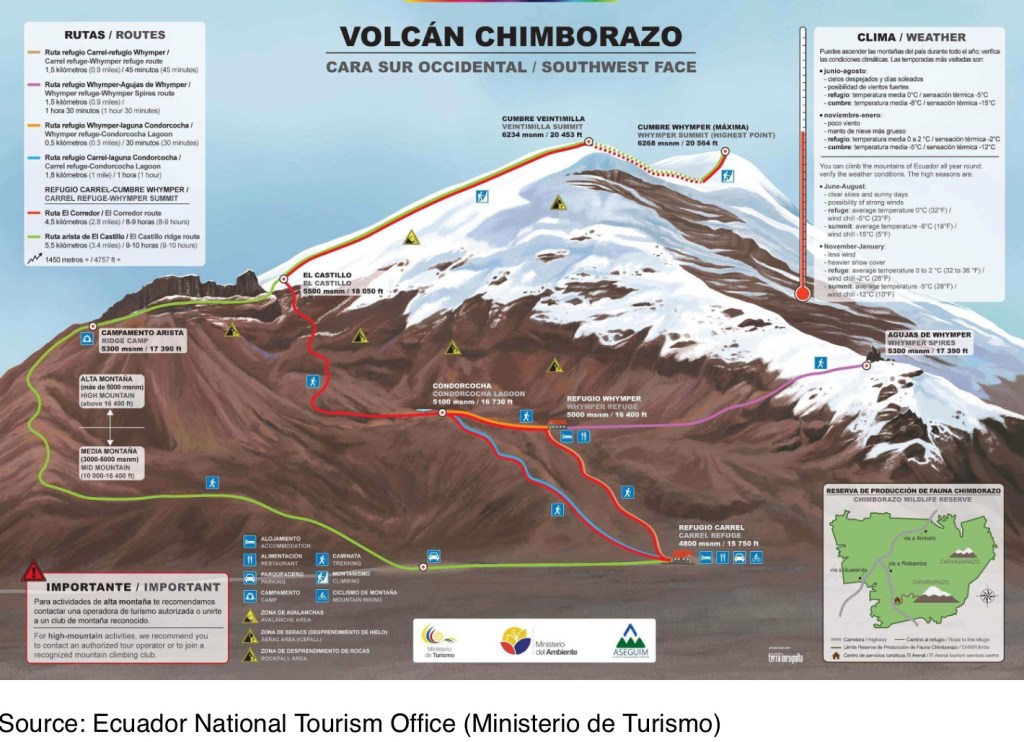
Our planned route takes us up a seemingly never-ending 40° slope that starts at the high camp [5,350m / 17,552’] and ends at the 2nd highest summit Pico Vientimilla [6,228m / 20,433’]. Then, it actually descends for a bit before sharply rising to the Whymper summit [6,267m / 20,562’]. Needless to say, any climb at these elevations is challenging.
Due to its height and location on the equatorial bulge, Chimborazo’s Whymper summit is the closest point on earth to the sun. When measured from the center of the earth, Chimborazo is more that 2.1km higher than even Mt. Everest!
The Climb
Our summit attempt began with an 2300 wakeup after a not so restful attempt to get about 5 hours of sleep. The geodesic dome, shared by 2 guides and 4 clients was surprisingly comfortable and quite roomy, allowing us to gear up before heading to the mess tent for a hot drink and light snack. Similar to the Cotopaxi summit night, the plan was to depart at midnight, but the route was much longer and steeper, so we steeled ourselves for a 7 hour ascent followed by a 3 hour descent back to high camp. Once there, we’d pack up and descend another 2,000 feet to the refuge, followed by a 4 hour car ride back to Quito… it would be a very long day!
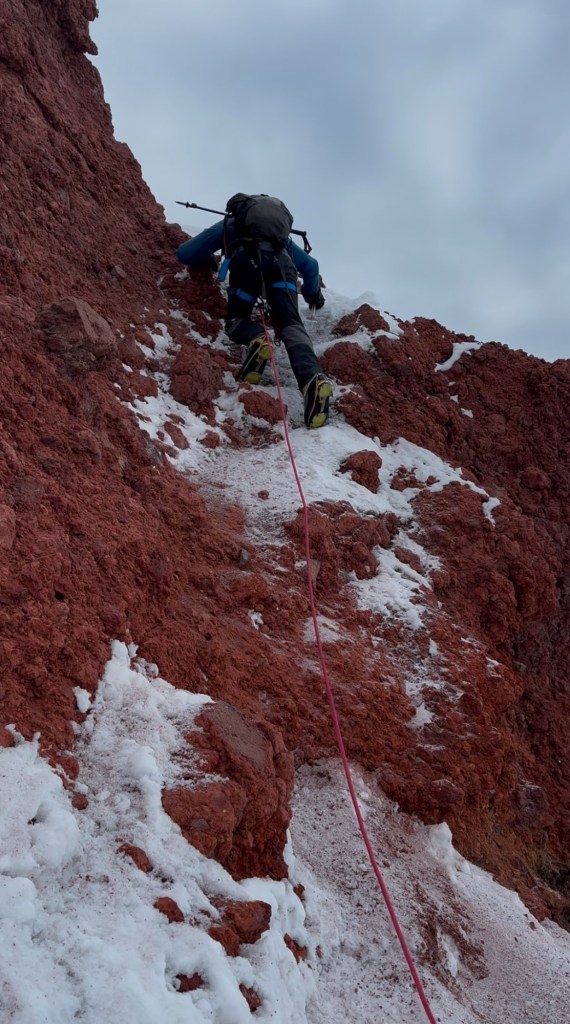
From the moment we left high camp, the trail was steep. At first we hiked along a coarse lava path at the base of a towering rock wall, called the Castle Ridge. At the end of this traverse, we had to scale a steep 35’ section of ice and snow encrusted lava rock that required the use of crampons to get a solid foot hold, the ice axe to implant in the rock/ice to gain a point of leverage, and the other hand to grab anything for balance and support. This rock climb at over 18,000’ of elevation in the dark of the night took quite an effort. Fortunately we were roped together and Camilo, our guide, provided a reassuring belay that added a measure of safety.
After the Castle Ridge, we were faced with an unrelenting 40° snow slope, aptly named “eternal ridge” that led to the Pico Vientimilla summit, over 2,000’ of elevation gain in about 0.5 miles… very steep!
To add to the difficulty factor, large sections of this snow path to the summit, featured powdery snow that caused you to slip partially backwards with each step taken… it was exhausting!
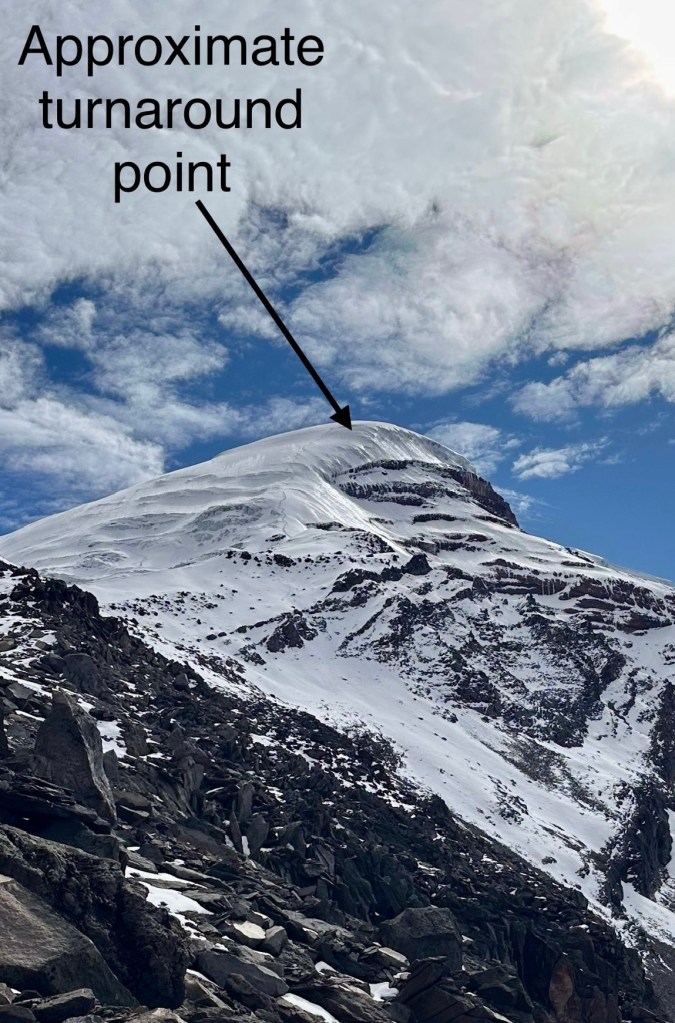
After 5 hours of effort, with at least another Two hours needed to get to the summit, Ron and I assessed our strength and what energy was still needed for the physically demanding descent, and made the hard decision to abandon the summit goal and begin our long descent. Even though we didn’t stand on Chimborazo’s summit, we still achieved a significant milestone for us, to get above 20,000’ elevation and bust through 6,000m elevation. We ended up getting to 20,055’ or 6,112m.
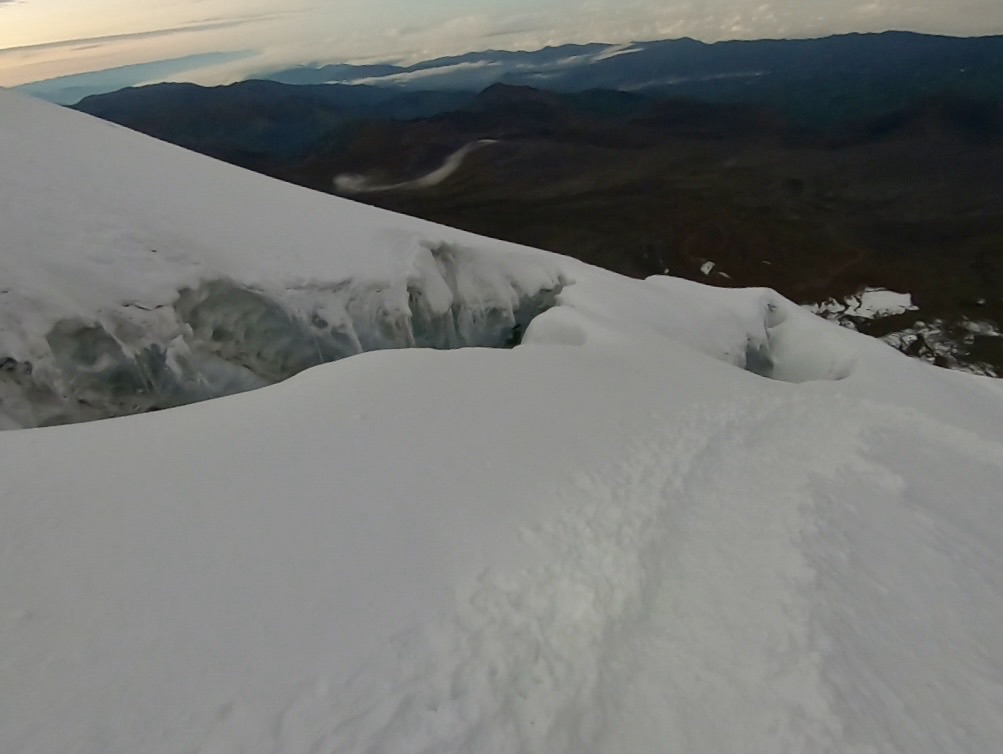
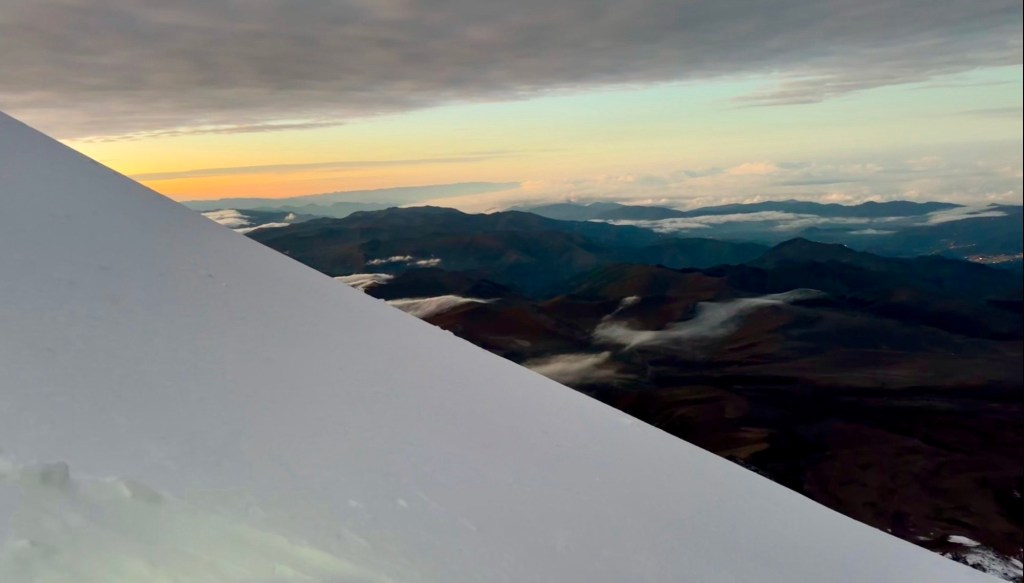

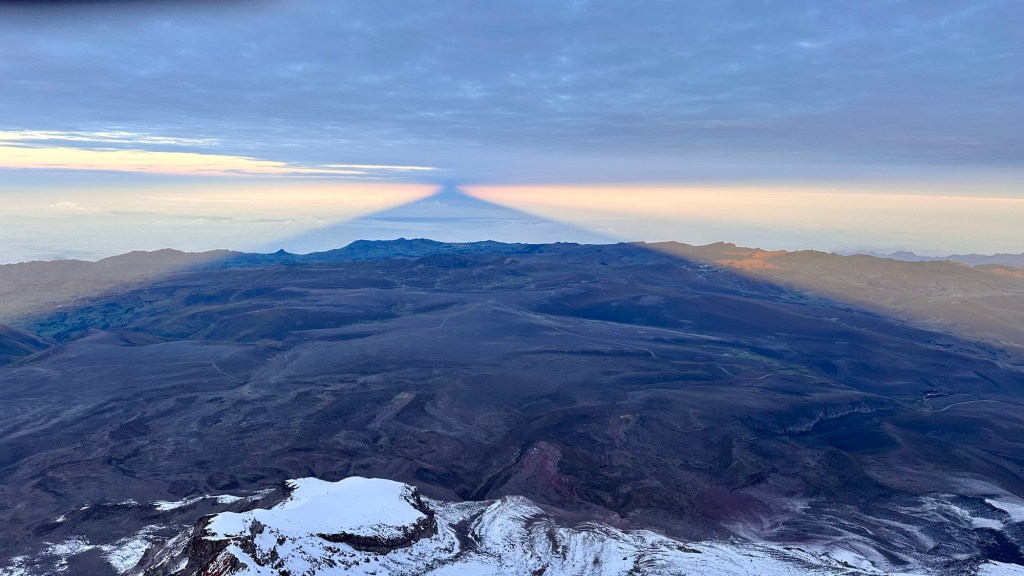
After a brief rest, we began the long slow 3 hour descent back to high camp, it was still dark, but we could still sense the significantly steeper terrain due to the strain in our legs. About 1 hour into the descent the skies began to lighten and we got our first real good look at the steep slope we were going down and how high we had climbed.

Finally, just before 8 am, we arrived back in high camp. We spent about 1 hour there to get a small bite to eat, and pack up our gear for the final 1.5 hour descent to the Refugio and our transportation back to Quito.
Epilogue
This entire trip was a great adventure that will be fondly engraved in our memories. Ecuador is a beautiful country with a rich history and stunningly varied regions.

Most of all it is the people we shared the experience with that made it truly memorable. We couldn’t have asked for better companions than Derrick, Allison, Chad, and Rebecca. And, our primary guide, Camilo, was not only one of the best in the business, but he was engaging, fun, and adventurous.

Author’s Note: If you enjoyed this post, leave a comment or repost to your social media. Also, feel free to explore past adventure series by clicking the “HOME” button below.
 Destination: Adventure
Good job Don & Ron! Thanks for sharing your adventure. You guys ROCK!
Jim & Linda Court
LikeLike
Thanks Jim and Linda… it was certainly a great trip with a lot of lasting memories. Hope all is well with you!
LikeLike
Congratulations on your latest adventure and enthralling play-by-play! I have to say your lodging seems a little more luxurious than our wind-battered tents in Iceland. Nevertheless, great job on another impressive expedition!
LikeLike
Thanks Chris! It was definitely a top notch trip with a lot of great memories… now back to work on S2S!
LikeLike
Don and Ron, congratulations on your remarkable achievements, summiting one challenging volcano and breaking through the 20,000′ mark on the other. Such tales you had to tell and in such interesting detail. I felt I was with you nearly every step of the way. Very well done. And your blog is terrific. Best I’ve seen. Am looking forward to seeing you in Buck Hollow and environs as you prepare for your next trip. Always a pleasure meeting the Alberto brothers on the trail.
Best, Wayne (Tom) Murray
LikeLike
Tom, thanks for taking the time to read the blog. We always enjoy running into you on the trail… hopefully we’ll see you soon!
LikeLike